RAF Halton
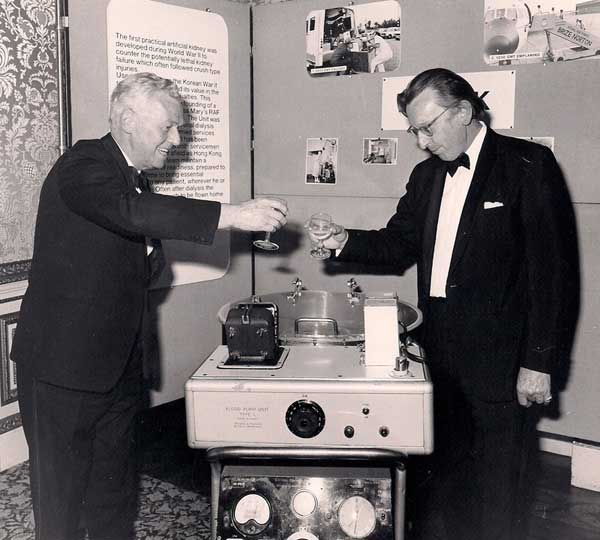
Sir Ralph Jackson and Jo Joekes at the 25th Anniversary celebration.
Responding to a wartime need
Many wounded Serviceman, initially saved by the greatly improved surgical and sterile techniques developed during World War ll, were only to die subsequently from renal failure. The need for an artificial kidney was given great priority by Service Chiefs in the RAF, who were much impressed by the results of dialysis on casualties in the Korean War (1950 – 1953). Major Paul Teschan had treated the first battle casualties with acute renal failure (ARF) in this conflict, where a reported 1 in 200 of all seriously injured casualties who survived the first 48 hours developed ARF. Using the Rotating drum, mortality fell from over 90% to approximately 60%. It was this demonstration of the utility of the artificial kidney in survival of ARF following trauma that stimulated the appointment of Ralph Jackson to set up a renal failure unit to support the British Forces around the World.
1956 therefore, saw the founding of the Royal Air Force Renal Unit by Group Captain (later Air Vice-Marshal Sir) Ralph Jackson at Princess Mary’s Royal Air Force Hospital Halton. Halton was the third UK unit to provide dialysis for acute renal failure. There had been a short-lived experience with acute dialysis at Hammersmith Hospital in 1946 led by Eric Bywaters and AM ‘Jo’ Joekes. The first unit to offer a long sustained acute dialysis service started in Leeds in 1956, and RAF Halton opened soon thereafter. Halton was the first to have the Kolff Twin Coil Dialysis machine in the United Kingdom. The Kolff Twin Coil machine had the advantage of being the lightest and most easily adaptable for transportation, and so most suitable for the Royal Air Force Renal Unit‘s aim to have the unique feature of mobility. The design of the original machine was significantly improved by an RAF technical unit with better electronic monitoring and more efficient blood pumping (Posselt BN et al. 100 years of the Royal Air Force’s contribution to medicine: Providing care in the air and delivering care by air. Clinical Medicine 2018; 18(4), 297–300).
The philosophy behind this mobile unit was simple: many patients who require kidney dialysis are too ill to be moved to specialised units, therefore the RAF Renal Unit moves to them. Flexible air and road transport allowed deployment of a mobile dialysis team plus equipment the length and breadth of the United Kingdom and as far afield as Hong Kong, Belize, Nairobi and The Falkland Islands. The facility was to be used not only for servicemen, but also to support patients with ARF and multiple organ failure in the NHS. One “mission”, where the equipment was delivered to the patient, including a photograph of the machine ready for transport and the weight involved, was reported by Honey & Jackson (Artificial respiration and an artificial kidney for severe barbiturate poisoning. Brit Med Journal 1959; ii(5160), 1134–1137). https://doi.org/10.1136/bmj.2.5160.1134).
The reputation and influence of RAF Halton
Amongst the many visitors from around the world to the new unit was Professor James Robson from Edinburgh in 1958. He visited three units carrying out dialysis at the time – Hammersmith, Leeds and Halton – to help decide which of the systems in use would be adopted in Edinburgh. In his report Robson demonstrated that Jackson and his team at Halton were not only the first to use the novel Twin Coil dialyser, but had added refinements allowing ultrafiltration and venovenous dialysis, benefitting from the blood pumps developed on site. Robson’s report HDinEdinI1958report strongly recommended the Twin Coil dialyser , which became the standard for the new dialysis units being established in Dublin, Belfast, Edinburgh, Glasgow, the Royal London and Royal Free Hospitals.
Jackson had been helped and supported in setting up the unit at Halton by Jo Joekes, who had been appointed Civil Consultant in kidney disease to the RAF. His experience at the Hammersmith Hospital in the early post war days with cBywaters in the treatment of ARF was to prove invaluable.
Jackson’s enthusiasm and constant improvements to the systems became legendary and clinicians visited from all over the world to learn from him and his team. The original machine was improved by the RAF technical unit to provide better electronic monitoring and more efficient blood pumping. His initial experiences with the Twin Coil were presented at the Royal Society of Medicine in 1958, and his success published in the British Medical Journal in 1960. 50% of those with trauma and ARF survived (Jackson RC. Experiences with the Kolff Twin Coil Artificial Kidney at the Renal Unit, Princess Mary’s Royal Air Force Hospital, Halton. Proc Roy Soc Med 1958; 51(12), 1071–1072).
In 1962, Jackson reported the first use of the artificial kidney in malaria with blackwater fever. (Jackson RC, Woodruff AW. Brit Med J 1962; i (5289): 1367-72).
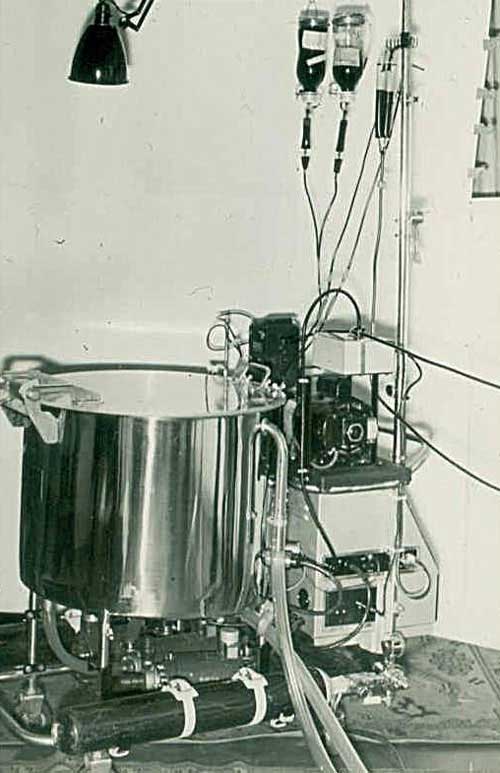 The RAF modified Kolff Twin Coil in action
Around the same time kidney biopsy techniques, pioneered in the UK by Jo Joekes, were entering regular practice; the investigation of kidney disease therefore became more sophisticated and the emphasis of the unit branched further into prevention and the development of treatments. The developments in renal biopsy were advanced further by the installation of an electron microscope at the RAF Institute of Pathology & Tropical Medicine.
End stage renal failure
By the early 1960s new developments in dialysis meant that patients with chronic renal failure could be treated on a long term basis. So in the later 1960s there began the second phase of the unit’s history with the introduction of a chronic dialysis programme, treating civilians in Buckinghamshire living in Aylesbury and the areas close to Stoke Mandeville and Halton.
Although the first renal transplant in a patient from Halton was carried out at St Mary’s Hospital in London, a strong liaison was developed with Sir Roy Calne and Dr David Evans at Addenbrooke’s in Cambridge, and all further transplants in Halton patients were done in Cambridge until the closure of the Halton Unit.
Leadership & Training
When Jackson moved on to become Senior RAF Consultant, Wing Commander CT (Tom) Flynn took command and brought many new techniques to the unit. He had spent some time in Jervis Street Dublin and learned to create his own Brescia-Cimino fistulae in addition to inserting all his own shunts. The “Flynn” shunt continued to be used for many years and vascular access surgery remained the domain of renal physicians until the unit finally closed. He also improved survival in ARF by using frequent dialysis to allow more rigorous intravenous feeding. He moved on to Des Moines Iowa to run the renal unit there after he left the RAF, where he gained great prominence by the innovative use of insulin in the dialysate to control the blood sugar in diabetics treated with chronic peritoneal dialysis.
Squadron Leader (later Air Commodore) David Rainford took over from Tom Flynn and took the nutrition work forward by introducing a more balanced parenteral feeding regimen as new products had become available. The unit was using intravenous low dose insulin at a dose of 1-2 units per hour with glucose infusions for several years prior to that technique being widely used in the management of diabetes with hyperglycaemia. With GI bleeding being a common cause of mortality in hypercatabolic ARF, intravenous cimetidine was first used at Halton in treatment and subsequently prevention for this high mortality problem.
Jackson, Flynn and Rainford were well known as unit pioneers and leaders, but many other well known nephrologists were trained by them at Halton and went on to other centres. Among Rainford’s senior registrars were: Charles Pusey, later to become Professor of Medicine at The Hammersmith , Lionel Bloodworth – Renal Physician at Bangor, Ed Peile – Professor of Education at Warwick, John Arm – Professor at Harvard and Paul Stevens- Director of the Kent Kidney Care Centre. Each contributed enormously to the development of renal care at Halton through their innovative ideas and enthusiastic dedication.
1980s and 1990s
In 1986 a new acute renal intensive care unit was opened and named “The Sir Ralph Jackson Unit”. The unit specialised in the severest of cases, especially those with multiple organ failure.
Haemofiltration techniques (pioneered by Paul Stevens) were introduced to transfer the sick from overseas to NHS units in the UK. Haemofiltration allowed fluid volume control at high altitude during aeromedical evacuation. High altitude haemofiltration Stevens 1986
Following the government’s Defence Costs Study, in 1995 the unit finally closed its doors with the reorganisation of Defence Medicine and closure of all service hospitals. The chronic renal failure programme was transferred to Oxford (which with only twelve months notice was able to increase capacity to treat all the transferred patients) and after nearly 40 years, the story comes to an end. After 23 years at Halton, Air Commodore Rainford went on to become Defence Postgraduate Medical Dean and retired as Chief Executive of the Defence Secondary Care Agency.
Further info
Read more about the RAF’s wider contribution to medicine over one hundred years 100 years of RAF contribution to medicine
Authorship
First published July 2022. Edited from John Hopewell’s collection of Renal Unit histories by Neil Turner & John Feehally.
Last Updated on November 11, 2026 by John Feehally