Southend
Southend Renal Unit 1980-1995
The beginning
Haemodialysis was started in Southend, Essex in 1982 with a small unit of four ‘minimal care’ dialysis stations run at Westcliff Hospital, under the direction of Dr Sophie Tomlinson, with dialysis staff being trained at The London Hospital, Whitechapel, London.
The enterprise was firmly supported by The London Hospital, but it had received some initial opposition in early 1980 from local hospital management in the form of Essex Area Health Authority and North East Thames Regional Health Authority.
Importantly the Southend and District Kidney Care Association, part of the British Kidney Patients Association (BKPA) led by Mrs Elizabeth Ward and locally by two highly motivated women, Audrey Murphy and Clare Harvey, recognised ongoing NHS funding at the start may be uncertain, and BKPA promised monetary support to continue the service if NHS funding became a problem.
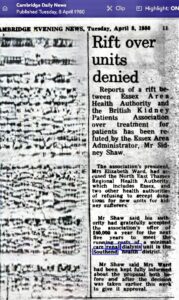 Cambridge Daily News 8th April 1980
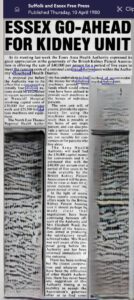 Suffolk & Essex Free Press 10th April 1980
It seems from these press cuttings that there were briefings about a rift between BKPA and Essex Area Health Authority, implying that the latter might not be fully committed to supporting the scheme. In retrospect it is unclear whether this was a genuine misunderstanding or perhaps a negotiating ploy by BKPA to ensure that NHS funding was not withheld. Whatever the intention, the apparent uncertainty drew a prompt refutation and a firm commitment from Essex Health Authority. Ultimately Essex Health Authority provided the building costs (~ £30,000), North East Thames provided the dialysis machines (~ £25,000) and BKPA the running costs of £40,000 per annum for the first 5 years.
Dialysis in Essex in the 1980s
At this time there were no other independent dialysis units in Essex, nor were there any satellite units in Essex associated with London renal units.
Other than Southend patients, those from elsewhere in Essex requiring dialysis had to travel into London for haemodialysis, with the exception of a small number of patients living in southeast Essex, and under the care of the London Hospital, who were on CAPD or home haemodialysis locally.
By 1989 15 patients were receiving twice weekly dialysis in the Westcliff Unit. A second consultant, Dr David Carmichael, was appointed in 1989, and the service was expanded with an increase in both patient numbers and dialysis frequency. Transplant patients under the care of London Hospitals were by then given the option to have long term follow up in Southend.
Distinguishing characteristics of the Southend Unit
At the Southend unit, there was reliance on non-nurse trained dialysis staff with a non-renal trained SRN sister in charge. The unit was instrumental in training staff without a nursing qualification, some had experience as health care assistants, but otherwise included people from a wide range of backgrounds. A training manual, based on The London Hospital Renal Unit training model, was further developed and eventually used in other dialysis units.
At that time any acute, inpatient dialysis was provided by the same staff under consultant supervision using a REDY machine. Haemofiltration was introduced on the ICU from 1989. A two bedded inpatient dialysis bay was opened, again with charity support, in 1991 on the ‘renal’ ward. CAPD was commenced on the unit in 1992.
One of the strengths of the dialysis programme was the partnership with vascular surgeons, Mr Colin Ware, Mr Mike Salter, Mr Alan Murray and Mr Matthew Jakeways. Their availability and versatility ensured a high percentage of patients started dialysis with permanent vascular access.
A new unit at Southend Hospital
As patient numbers increased it became apparent that a small haemodialysis unit away from the main Southend Hospital site was unsustainable. The main Southend Hospital was being redeveloped and with additional charity money a purpose built 18 station unit was planned and eventually opened in September 1993; The official opening was marked by the visit of The Duchess of Gloucester GCVO in 1995.
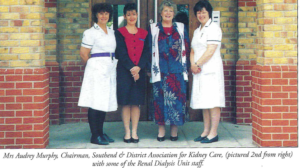
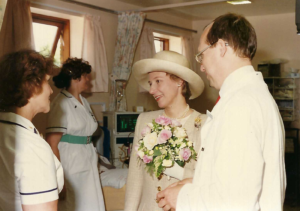
HRH Duchess of Gloucester with David Carmichael & nursing staff
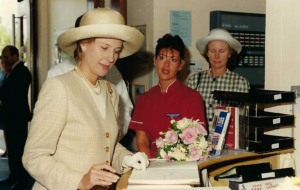 HRH Duchess of Gloucester signing the visitors book
Expansion to Basildon
Dr Sophie Tomlinson retired soon after the new unit opened, and an additional consultant, Dr Michael Almond had already been appointed in June 1993. By this time patients were being accepted from Basildon Hospital significantly increasing dialysis patient numbers. Dr Almond’s appointment was made jointly with Basildon Hospital with the intention that he would provide outpatient clinics, inpatient consultations and develop plans for a new haemodialysis unit on the Basildon site. This was achieved within 2 years.
Reference: The Hospitals of Southend. Jefferies and Lee 1986. Pub; Phillimore and Co Ltd. ISBN 0 85033 591 4
Michael Almond, David Carmichael
Last Updated on November 17, 2026 by John Feehally